At EIEAS, we firmly ground our approach in established psychological principles. Awards and certifications are effective because they fulfill core human needs, activate neurochemical reward pathways, and reinforce high-value behaviors—making structured recognition a scientifically proven driver of motivation and peak performance.
🧠 Psychological Foundations of Recognition
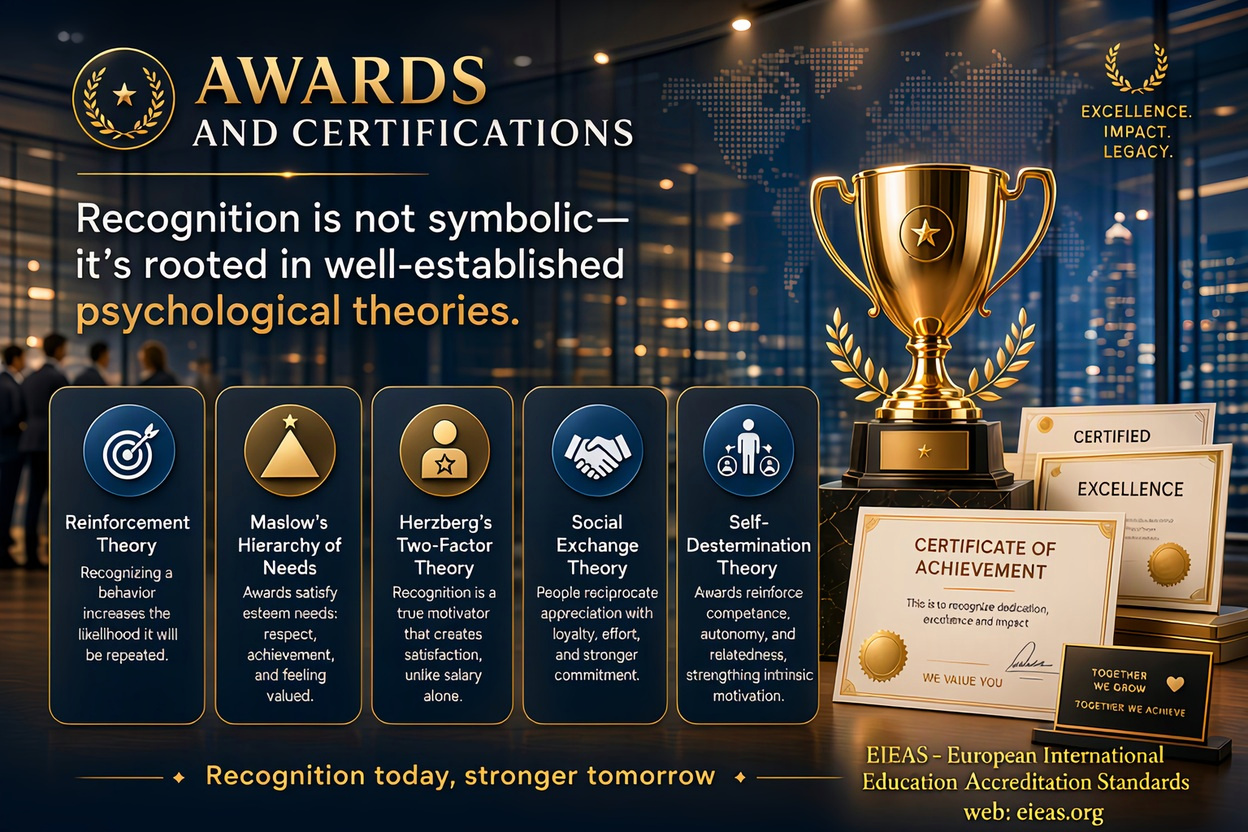
Recognition is not symbolic—it is rooted in well‑established psychological theories.
- Reinforcement Theory — Recognizing a behavior increases the likelihood it will be repeated.
- Maslow’s Hierarchy of Needs — Awards satisfy esteem needs: respect, achievement, and feeling valued.
- Herzberg’s Two-Factor Theory — Recognition is a true motivator that creates satisfaction, unlike salary alone.
- Social Exchange Theory — People reciprocate appreciation with loyalty, effort, and stronger commitment.
- Self-Determination Theory — Awards reinforce competence, autonomy, and relatedness, strengthening intrinsic motivation.
These theories explain why recognition feels meaningful and why its absence leads to disengagement.
🧬 Neuroscience: Why Awards Change Behavior
Recognition triggers measurable biological responses:
- Dopamine release — Praise activates the brain’s reward system, creating pleasure and reinforcing the recognized behavior.
- Serotonin release — Boosts mood, confidence, and well‑being, strengthening long-term satisfaction.
- Anticipatory reward activation — Knowing recognition might follow good work increases motivation even before the award is given.
This neurochemical cycle explains why even symbolic awards (certificates, plaques, public praise) can dramatically increase motivation.
💼 Behavioral and Performance Impacts
Across studies, recognition consistently improves measurable outcomes:
- Higher productivity, engagement, and profitability
- Lower turnover and burnout — Recognized employees are far less likely to quit or experience chronic stress.
- Greater innovation and risk-taking — Recognition builds psychological safety, enabling creativity.
- Stronger organizational culture — Awards clarify what “good” looks like and reinforce shared values.
Awards and certifications act as behavioral signals: they show what matters, shaping norms and expectations.
🏆 Why Awards and Certifications Feel So Powerful
Awards are more than tokens—they are identity markers.
- They validate competence and reinforce self-worth.
- They serve as lasting memory anchors, strengthening confidence over time.
- They create public acknowledgment, amplifying social status and belonging.
- They set benchmarks for excellence, motivating peers to improve.
This combination of personal validation and social signaling explains why certifications and awards often accelerate career growth.
🎯 What Makes Recognition Effective
Research shows recognition works best when it is:
- Timely — Close to the achievement
- Specific — Naming the exact behavior increases clarity and impact
- Authentic — Genuine praise triggers stronger psychological responses
- Visible — Public recognition boosts morale and reinforces norms
- Personalized — Tailored awards resonate more deeply than generic ones.
These principles explain why poorly executed recognition feels hollow—and why well-designed programs transform performance.
⚖️ Balancing Extrinsic and Intrinsic Motivation
Awards can motivate, but over-reliance on external rewards may crowd out intrinsic motivation.
The most effective systems:
- Pair awards with autonomy, mastery, and purpose.
- Recognize effort and growth, not just outcomes.
- Use awards as reinforcement—not the sole motivator.
✅ Practical Implications
For organizations, awards and certifications are strategic tools that:
- Strengthen culture
- Improve retention
- Increase performance
- Build psychological safety
- Encourage continuous learning.
For individuals, recognition enhances confidence, identity, and long-term motivation.