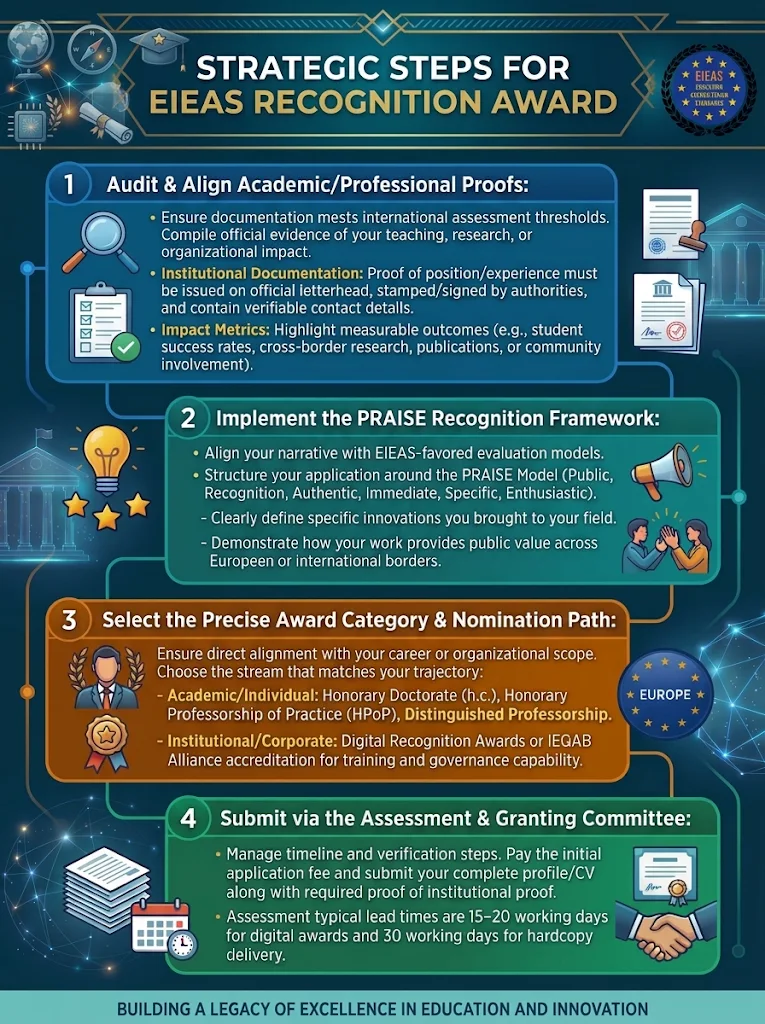
Distinguished European Recognition Awards: These elite, high-prestige accolades celebrate pinnacle achievements and transformative excellence across diverse sectors throughout Europe and globally. EIEAS honors visionary institutions, elite professionals, and pioneering enterprises for their extraordinary impact, enduring contributions, and commitment to driving exceptional innovation and leadership.
| EUROPEAN PROFESSIONAL CERTIFICATION ACCREDITATION (EPCA) | EUROPEAN INTERNATIONAL EDUCATION ACCREDITATION STANDARDS (EIEAS) |
| INSTITUTIONAL GOVERNANCE & CREDENTIALING ARCHITECTURE
European Professional Certification Accreditation (EPCA) EPCA by EIEAS — Official Credentials Recorded in the EIEAS Official Registry and Directory Strategic Framework, Core Principles, and Accreditation Standards for Cross-Border Recognition of Licensed Professionals Type: Foundational Framework & Operating Standards | Scope: European & International Licensed Practitioners | Registry: EIEAS Official Registry and Directory |
|
1. MANDATE & STRATEGIC POSITIONING
The European Professional Certification Accreditation (EPCA) by EIEAS is conceived as a specialized, independent personnel certification and credential recognition body. Its primary mandate is to evaluate, validate, and confer supplementary international designations upon professionals who already hold active statutory licenses, regulated charters, or verified academic and professional standing within European or international jurisdictions.
Unlike primary licensing boards—which grant the initial legal right to practice within a single
national territory—EPCA operates on a Validation-of-Standing and Value-Added
Credentialing Model. By auditing an applicant’s existing licensure, documented career
achievements, ethical standing, and continuous professional development (CPD), EPCA translates localized or sector-specific credentials into a unified, internationally intelligible mark of professional distinction.
2. TIERED PROFESSIONAL CERTIFICATION PATHWAYS
Because licensed professionals enter EPCA by EIEAS at distinct stages of career maturity and international scope, the authority confers six progressive credential tiers mapped to the European Qualifications Framework (EQF). Every conferred designation is recorded with its EQF alignment in the EIEAS Official Registry and Directory.
| EPCA Designation | EQF Alignment | Minimum Eligibility & Prior Achievement | Assessment Mechanism |
| EPCA – European Certified Associate Practitioner (ECAP) | EQF Level 6 | Active primary statutory license or accredited bachelor’s-level professional registration plus minimum 2 years of verified supervised or independent practice. | Primary license verification, employer/regulator attestation, ethics compliance check, and EIEAS Official Registry and Directory indexing. |
| EPCA – European Certified Specialist (ECS) | EQF Level 7 | Active statutory license in good standing plus minimum 5 years of post-licensure practice and documented specialization (postgraduate diploma, specialist board, or portfolio of complex projects). | Two-assessor portfolio audit, verified case-study evaluation, and structured competency review. |
| EPCA – European World Professional Certified (EWPC) Global Cross-Border Professional Designation |
EQF Level 7 | Active statutory license in good standing, minimum 7 years of verified post-licensure practice, documented cross-border or international professional execution, and mastery of multi-jurisdictional standards. | Two-assessor cross-border portfolio audit, verified international practice dossier review, and EIEAS Official Registry and Directory verification. |
| EPCA – European Senior Fellow (ESF) | EQF Level 7–8 | Minimum 10 years of licensed practice with senior leadership, cross-border project governance, regulatory advisory roles, or significant peer-reviewed/technical publications. | Senior Peer-Panel dossier review, two executive referee validations, and formal panel interview. |
| EPCA – European World Master Certified (EWMC) Global Master Practitioner Designation |
EQF Level 8 | Active statutory license or terminal master/doctoral standing plus minimum 12–15 years of distinguished executive, technical, or institutional mastery with demonstrated global/cross-border impact, authored standards, patents, or high-level governance leadership. | Senior Master Peer-Panel comprehensive audit, two international executive/academic referee validations, formal executive defense interview, and EIEAS Official Registry and Directory publication. |
| EPCA – European Distinguished Laureate (EDL) | EQF Level 8 (Honorary / Merit) | Exceptional, internationally recognized lifetime contribution to professional standards, scientific advancement, public policy, or cross-border institutional capacity building. | Invitation or peer nomination only; unanimous ratification by the Governing Council and EIEAS Official Registry and Directory honors induction. |
3. APPLICATION, AUDIT & CONFERRAL WORKFLOW
To ensure predictable turnaround times and rigorous audit trails, EPCA by EIEAS processes all candidate applications through a standardized six-step operational pipeline:
- Step 1 — Preliminary Eligibility Screening (Days 1–5): Candidate submits digital identity credentials, primary license numbers, and summary curriculum vitae. Administrative officers confirm baseline jurisdiction eligibility prior to full dossier assessment.
- Step 2 — Structured Dossier Submission (Days 6–20): Candidate uploads notarized or digitally verifiable copies of licenses, academic transcripts, Certificate of Good Standing, CPD logs, and up to five corroborated achievement exhibits.
- Step 3 — Primary Source Verification (Days 15–30): Verification specialists contact issuing regulators and institutions directly to authenticate credentials and confirm good standing.
- Step 4 — Technical Peer Assessment (Days 31–45): Assigned domain assessors evaluate the dossier against EPCA-PAS 100 standards and complete the Prior Achievement Credit Matrix. For Senior Fellow (ESF) and European World Master Certified (EWMC) candidates, a 45-minute structured panel interview is conducted.
- Step 5 — Certification Committee Ratification (Days 46–55): An independent Certification Committee reviews the complete audit trail, resolves any scoring variances, and issues the formal conferral decision.
- Step 6 — Issuance & EIEAS Official Registry and Directory Publication (Days 56–60): Successful candidates sign the EPCA Code of Professional Conduct, receive their serialized EPCA by EIEAS certificate and verifiable digital credential, and are published in the public EIEAS Official Registry and Directory.

European Professional Certification Accreditation (EPCA by EIEAS) — Strategic Framework & Standards